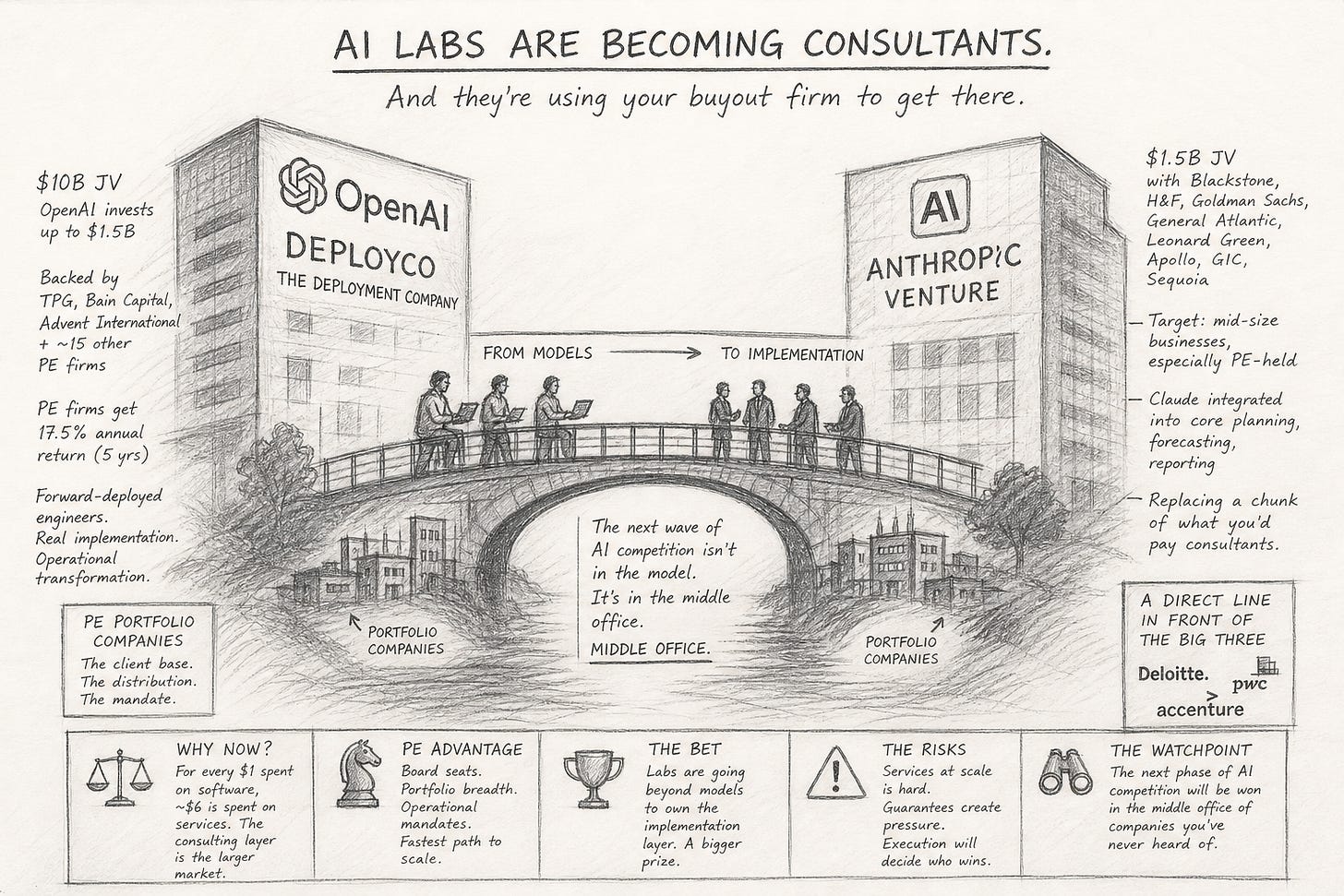
On the same morning in May 2026, OpenAI and Anthropic each announced separate joint ventures with some of the largest private equity firms on the planet. Different structures, different partners, same underlying logic: the future of AI revenue isn't in selling API tokens. It's in running implementations.
OpenAI's DeployCo
OpenAI closed a $10 billion joint venture called The Deployment Company (DeployCo), anchored by TPG, Bain Capital, Advent International, and roughly fifteen other PE firms. OpenAI itself is committing up to $1.5 billion. Brad Lightcap, previously OpenAI's COO, is running it.
The structure is deliberate. DeployCo is a Delaware LLC with OpenAI holding super-voting shares: minority capital, majority control. PE firms get a guaranteed 17.5% annual return over five years. In exchange, their portfolio companies become the client base.
What DeployCo actually does is straightforward: it embeds forward-deployed engineers inside portfolio companies to implement AI systems, automate workflows, and restructure operations. Think Palantir, but built by the company that makes the model.
The business logic is obvious once you see it. PE firms hold board seats across hundreds of companies. A single GP signing onto DeployCo brings dozens of portfolio mandates with it. Instead of convincing a skeptical CTO at a mid-size manufacturer, you go directly to the owner and make it part of the thesis.
Anthropic's Venture
Anthropic went in a similar direction with different partners. Its joint venture, a standalone $1.5 billion entity, brings in Blackstone, Hellman & Friedman, Goldman Sachs, General Atlantic, Leonard Green, Apollo, GIC, and Sequoia. Anthropic engineering resources are embedded directly in the new firm.
The stated target is mid-size businesses, particularly PE-held ones, where Claude gets integrated into core planning, forecasting, and reporting functions. The explicit pitch to sponsors is that this replaces a chunk of what you'd otherwise pay a brand-name management consultancy to do.
That's not a subtle positioning choice. It's a direct line drawn in front of the Big Three.
Why This Makes Sense
There's a familiar ratio in enterprise software: for every dollar spent on software, roughly six dollars gets spent on services. The consulting layer has always been the larger market. AI labs have spent the last few years building extraordinary models and then handing them off to system integrators, boutique consultants, and in-house IT teams to actually deploy.
The results have been inconsistent. Enterprises struggle with implementation. Adoption lags. ROI cases remain vague. Demos are impressive, deployments are not. And in that gap, the AI labs get blamed for products that are either not ready for these use-cases, or were never properly deployed.
If the correct diagnosis is the latter, building the services arm is a way to control the outcome.
If the former is more correct, which I believe it is, then it gives these engineers a real view into the failure modes in production, and that information will be gold to the research teams. I think these models are highly capable, but are missing a crucial link to human expertise that will give them a much better shot at producing real work.
There's also a competitive angle. OpenAI and Anthropic are racing on two fronts simultaneously: model capability and enterprise penetration. PE firms, with their portfolio breadth and operational mandates, offer the fastest path to deploying at scale. 85% of buyers reportedly now factor AI-enabled capabilities into valuations. That gives the AI labs real leverage in structuring these deals.
What's Different Here
The consulting industry has absorbed technology waves before. ERP, cloud migration, digital transformation: each generated enormous services revenue for Accenture, Deloitte, and the strategy firms. The integrators always won.
This time, the model makers are trying to own the implementation layer themselves. That's new.
Whether it works depends on execution. Forward-deployed engineers at scale is hard. The Palantir model took years to operationalize and required a specific kind of institutional patience. OpenAI and Anthropic are moving faster, with more capital, but also with less operational services experience.
The guarantee structure in DeployCo is also a notable commitment: 17.5% annual returns to PE isn't venture-style upside sharing. That's a yield product. If the enterprise deployments don't generate sufficient value to sustain those returns, the structure gets complicated quickly.
Anthropic's setup is less explicit about return commitments, which may reflect a more conservative posture or simply a different negotiating position with its partners.
Both ventures represent a bet that the next phase of AI competition isn't fought at the model layer. It's fought in the middle office of a portfolio company in Ohio.
That may be right. It's also a very different business than building frontier models.
We'll see if the labs are good at both.
Finally, there is an ominous undercurrent to this strategy. Intentionally or not, the AI labs have been replicating most of the business value-proposition of certain billion dollar SaaS firms as mere feature releases in their products. The most valuable data that currently exists is what they couldn't scrape off the internet to train their models.
This data is the domain-expertise that lives in small, medium and large enterprises. The deployed AI engineer is a two-way street. The firm gets access to AI expertise, but at the same time valuable domain-expertise is also being exposed to employees of the big AI labs. Firms that engage in this manner and if their business model is mostly software - may come to regret the tradeoff.