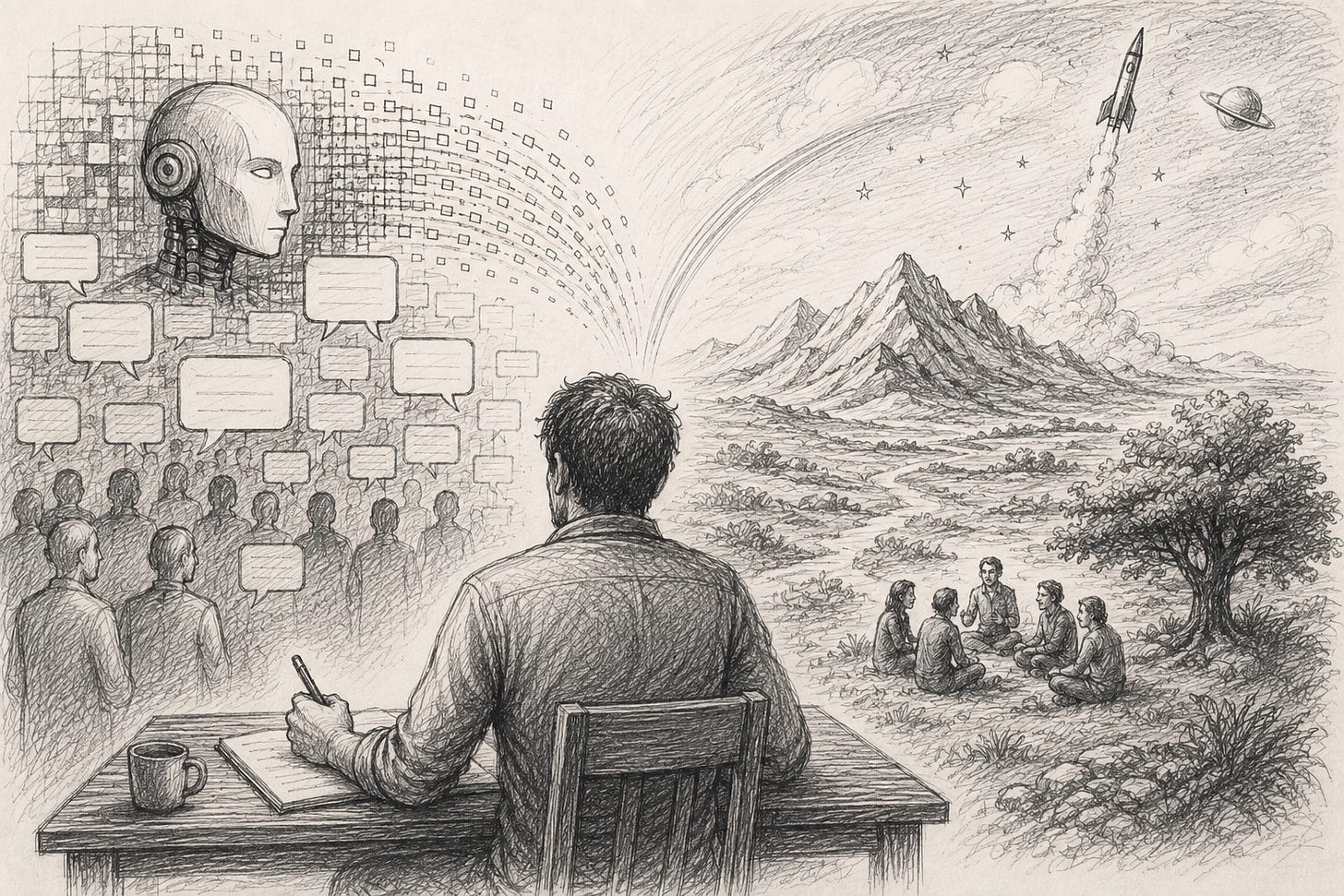
The Turing test and intelligence in general is premised on language. It makes sense, language and communication lifted our species out of the savannahs and open land and into orbit around Earth and beyond.
Language is also why ChatGPT became a phenomenon in 2022. After all, it's in the name. A Large Language Model. The transformer technology, reinforcement learning methods, agentic looping - is all a giant human and capital effort around taming bits and bytes to produce comprehensible output.
And man, has it succeeded! The effectiveness of next token prediction to produce cogent "thought", essays, stories etc. was unexpected, and an understatement to say that it took over the imagination of hundreds of millions of people around the globe.
"I use it all the time for email" - is a phrase I hear from my circle of friends, and data supports that this is the top use-case for people in general, especially for work. People are using it to write email, comment on social media, and make linked-in posts.
Oh, those linked-in posts! It is ubiquitous, and I see communication from organizations and leadership all the time, that is one copy-paste away from confirmation that it is "100% AI". This even works with anti-AI posters, not rare to see them generating their anti-AI rhetoric with AI.
I might as well come clean right now. I have used AI to "write". I have used AI to edit, and sometimes taken ideas from AI on rephrasing etc. Most of my motivation, as it is with all things AI - is to see how far I can push the tech. How good is the current state of art on a given task, whether it is data analytics, coding, song-generation, or writing. I have been thinking hard about writing in particular, and something changed about a month or two ago.
After tinkering with LLMs for writing, and seeing how this activity is pervading the web and communication in general, I have reached a conclusion. This is bad, and communication isn't a great use-case of LLMs.
This is a bit of a hot-take. While people don't like the idea of spending their time reading AI output, at the same time there has never been this many people who don't have a problem generating such output for others. So much so that platforms like substack and others have set up AI output detectors. Linked-In was spamming its users with "would you like to rewrite this with AI" prompts, and is now adding a flag on posts for users to indicate "Seems like AI Slop".
For a lot of people, their reaction at AI posts falls in one of these bins:
- They think LLMs are bad at writing.
- They feel that their time is disrespected if someone sends them an AI-generated email or report, article, etc.
The current annoyance at "AI Slop" is dependent on the fact that people can tell it was written by Claude or some AI. Each AI has particular phrasing quirks, and people have learned to clock these. Sometimes they consider these AI-tells as bad writing. A lot of them think this is a fundamental limitation with LLMs. I'm not so sure about that.
The reason I have come to my conclusion isn't because AI is necessarily bad at writing, or that it couldn't get better. In fact, I would bet that it would get better. Em-dashes, "it's not this, it's that", and all these Claudish phrases can be ironed out, easily. The entire writing personality of an LLM can be revamped with one RLHF pass or even a prompt. You can easily create pieces of writing that are un-detectable as AI. The models are getting bigger and better. I would even say that these models are already capable of writing much better than an average person.
Quality is not the issue. My concern is simple. A piece of LLM writing is not Me. And it's not You.
Writing an email or a post is very different than writing code. A code is a set of instructions and all that people care about is whether they work or not. People are not looking at your code as a window into your soul. Well, not most of us anyway!
When you write, you are communicating much more than the semantic meaning in the words. People think its coming from you. Your thoughts, your mind. The way that you talk and the way your brain processes information and produces words. They feel cheated when they find out that it wasn't you. They lost the time that they spent trying to get closer to you by reading what they thought were your words.
I'd go as far as to say that editing with AI is also not great. Typically AI re-phrases sentences that read much better, they read like the polished articles you see online - much of which are training fodder for LLMs, so it's no surprise. But it's not you. And it's not me.
Over the course of my life, some have liked my writing - but I've also been told many, many, times about the various ways I come up short. The way I construct sentences, mess up object and subject and other grammatical atrocities that I don't shy from. I even invent new words sometimes. All of it is true to who I am, how I think, and how I write. I write like I talk. Reading my writing should feel like having a conversation with me.
Obviously there are little things like spelling, but we have had the red squiggly spell-checking for decades. That's alright. And sometimes you do want additional help with work product that needs polishing. Again, most of us are not reading a piece of technical work memo as window into your soul. But email? Social media? thought-leadership?
If there's anything that you want to come across as a window into your mind - then I think you should avoid running it through an LLM filter.