If you've been using ChatGPT or Claude or Gemini for a while, you've probably noticed they're getting better at remembering you. That's intentional. Memory is one of the biggest features the labs are racing to build, and the lock-in implications are significant.
Switch from Claude to ChatGPT, and you start from zero. All that accumulated context - your preferences, your projects, your way of thinking stays behind. That switching cost is exactly what the labs want. It's the same playbook as cloud vendors in the 2010s: make it easy to get in, expensive to get out.
But it doesn't have to work that way. Your memory should travel with you. As a user, I want my context available wherever I choose to work - not just in chat apps, but in coding agents like Claude Code, OpenCode, or Codex. The ability to switch models and harnesses freely is where I want to be. It's where the big AI labs and SaaS vendors don't want me to be.
There's a practical solution, and it's almost free. You can run your own MCP (Model Context Protocol) server that stores your key thoughts and context in a database you own. Any AI tool that supports MCP - and most of the good ones do - can read from and write to it. Capture a thought from Claude, retrieve it in ChatGPT, reference it mid-session in a coding agent. Same brain, every tool.
Nate Jones wrote an amazing post that my experimentation is entirely based on. It is here: promptkit.natebjones.com. I edited it to remove dependence on Slack. I don't use Slack, and think it is unnecessary here. You can simply say in ChatGPT, Claude or whatever that "please store this memory in memex" - and it will do it. I call it memex, Nate calls it "open brain", you can call it whatever you like.
I've built and been running this for a few days now. It is practically free. The cost is roughly $0.02-0.30 a month depending on usage. No SaaS subscription, no vendor dependency, no lock-in.
I call it Memex. The full setup guide is verbagpt.com/memex-setup-guide.html - it takes about 20 minutes and requires no coding. I don't want to overplay this either, while it doesn't require coding - it is still a little bit technical. You have to set up a free-tier Supabase database. The instructions are simple, but they aren't easy to those that have never done technical things. I think this will quickly change and I think/hope there will be a free open-source plug-n-play solution. Until then, this is the best we have - and in the last few days, I've loved using it.
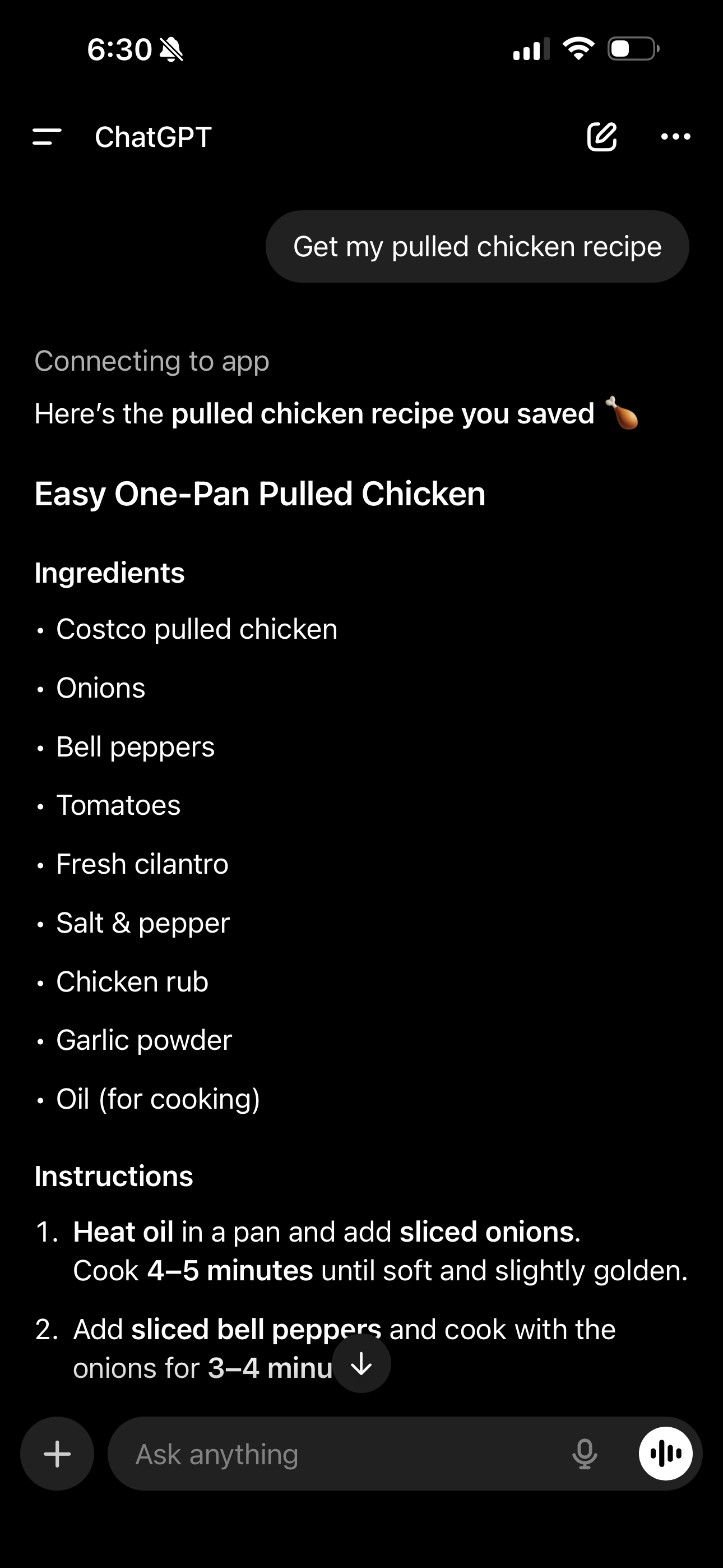
Here is me talking to Claude and telling it to store a recipe. And the next image is me retrieving it from ChatGPT a few seconds later. Memory liberated!

Here is me retrieving it from ChatGPT a few seconds later after audio-input from Claude:
The deeper point is this: memory portability is the personal equivalent of model-agnosticism. I wrote about model lock-in some time ago at the infrastructure level. Owning your memory is the same principle applied to your personal context. Convenience today - letting a single platform hold your brain - creates strategic vulnerability tomorrow.
Own your memory. The tools are already there.