Late last year questions were swirling around the progress of AI. I guess they still are today, but the skepticism was resonating with me more then. At the end of last year, the story was all about the foundational models. When will the next ChatGPT moment be? Will GPT5 lead to AGI? Will DeepSeek change everything?
Then progress started to plateau. Foundational model improvements began to seem less radical than before. This is expected, it is easier to improve 10x when you are starting from near-zero, and making further improvements to good models gets progressively harder. Also, it became more difficult to see how foundational models and a single-turn Q/A chat could interface effectively with the real world.
Enter "Agentic AI". I don't love the phrase, and it seemed to me like an attempt at papering over the cracks in foundational model reasoning and understanding with a layer of compute. If the model is so smart, why does it need so many attempts, direction and redirection?
Over the last few months, I've changed my mind. Agentic AI, as terrible of a buzzword as it is, is more than just loops, context, and redirection. The sum is greater than the parts, and I've vibe-coded my way to a few realizations.
The so-called vibe-coding is an easy target for mockery. Security holes the size of the Grand Canyon, generic looking apps, ideas looking for market-fit that are further off-course than Columbus was when he was searching for India.
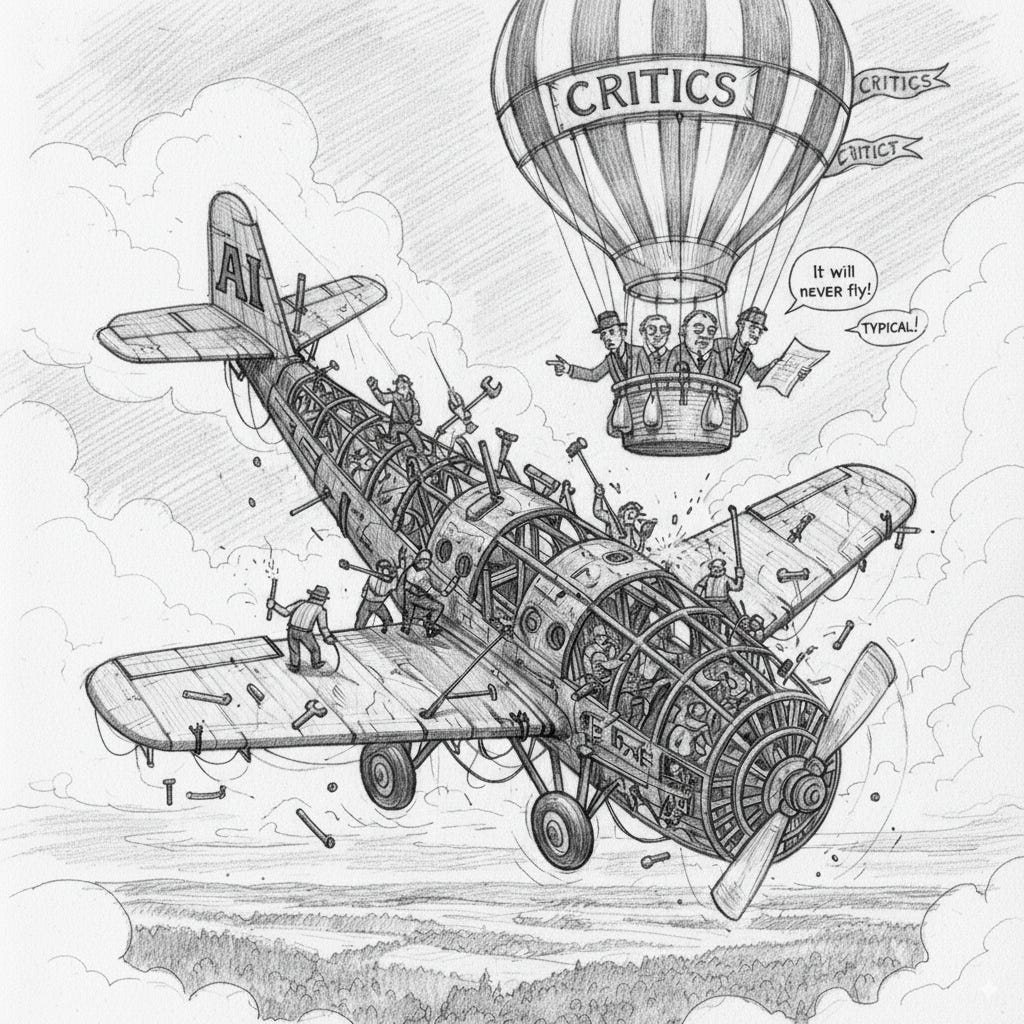
As usual, most are missing the forest for the tree-stumps. The fact that today anyone can create a fully functional app in a few days at all from just being an AI-whisperer, isn't short of astounding. Anything the critics can point to is but a temporary pain.
Sure, it doesn't work like you may see on social media. Today you can't just make a wish, press enter and go make coffee; and a fully polished app awaits you on your return. In my experience anything more complex than a simple website or webapp puts you on a crash course towards becoming a software engineer. You run into bugs, you debug, you debug the debugs, and soon just want to bug out. You learn how to github, you learn how to VSCode, you learn how to Claude Code in CLI, you learn a lot. One of the things that you learn is that LLMs are very good at confidently declaring that all your problems are fixed and apologizing profusely when you point out that they aren't. And doing it again, and again. LLMs have zero shame.
I digress, let me try and find my way back to my point. Even with all these gripes, the fact that LLMs through repeated incantations can resurrect some version of your vision - is powerful evidence that a future can exist where you can simply speak ideas into existence.
Another popular criticism is that LLM-assisted coding is leading to technical debt and vulnerabilities. Security? You really think that an agent that can hack together a full-stack app with auth, crud, payment, multiple integrations, and a myriad of complex features can never implement security best-practices? I'd have to suspend a lot of disbelief to believe that. I think that in a not-too-distant future, the vibe coders will be building apps that are more polished and more secure than what took startup teams months to accomplish in the past.
I fully expect stories of woe in the mean time. People revealing API keys, confidential data leakage, apps breaking down in hilarious ways. I expect plenty of arguments for the critics, and lots of memes. This will not change my thesis that a generative AI wave is coming, and even though the critics seem to have ample ammunition today, it won't be enough to shoot it away tomorrow.
I only need to point to one thing as proof of my thesis. I needn't point to the marketing, startup valuations that are bubblier than menthos in a coke, or all the familiar 'influencers' getting paid to hock the latest model, agent, or startup. I just need to point out that any available inference capacity is getting mopped up. The world is consuming inference faster than they can produce it. Sure a lot of the output is slop today, but developers understand where this train is headed. Keep an eye on the builders. As the adage goes - you can't fool them all, all of the time. And they are all building.
For the first time, I no longer see an insurmountable obstacle to most digital workflows coming within the circle of competence of an AI agent at some point in time. And that is a lot of workflows. This circle of competence is pretty tiny today, but it will only grow from here.
When will it happen? It could be in a year, it could be ten years. I find some solace in that our very reality makes it impossible to know both the position and the speed of any piece of matter. I am fairly certain about the heading of this plane, I am less certain about when it will land there. Let's just say that I wouldn't at all be surprised if it lands there far, far short of a decade.
All this doesn't mean there aren't question marks over the technology, or dangerous landmines in adoption and implementation. It doesn't even mean that I cheer all the changes and what they might mean for society. But that is a different article (or few), and I'll share my thoughts on that another time. Till then, keep experimenting and learning!